
Sacred Buzz - Sacred Buzz
Repetition has always possessed a peculiar power in psychedelic music. Play something once and it is a riff. Play it repeatedly and, somewhere along the way, it can become an environment. The notes stop drawing attention to themselves and begin altering the way everything surrounding them is perceived.
For Sacred Buzz, that transformation appears to lie at the heart of their first full-length album.
Due for release on October 9, 2026 through Sound Effect Records, the self-titled Sacred Buzz finds the Berlin-based quartet expanding considerably upon the raw psychedelic garage of their earliest recordings. The fuzz, organ, repetition and physical momentum remain, but the two songs revealed ahead of the album suggest that the group has begun thinking on a considerably larger scale, allowing krautrock, post-punk, garage rock and neo-psychedelia to dissolve into something darker, more immersive and increasingly cinematic.
At approximately 42 minutes across only eight tracks, this is clearly not an album designed around brevity. Sacred Buzz appear much more interested in establishing environments and then remaining inside them long enough for repetition to begin changing their character.
The group itself is relatively young.
Sacred Buzz formed in Berlin during the summer of 2023, initially around guitarist and vocalist Ivan Skvortsov and keyboard player and backing vocalist Jane Skvortsova. The beginnings were pleasingly informal. Ivan and Jane invited their neighbour, bassist Luca Büttner, and his friend, drummer Max Storck, to play with them. The chemistry apparently emerged quickly enough for Sacred Buzz to begin performing within Berlin's underground circuit, including appearances at Urban Spree.
From the beginning, their musical language was already built around several forms of repetition.
Psychedelic rock provided the colour, garage supplied the abrasion, while krautrock and motorik rhythms gave the music forward movement. Drone added another dimension entirely, allowing individual sounds to persist long enough to become part of the atmosphere rather than merely components of conventional song structures.
The original line-up introduced that approach through the “Radio Radiation / Rebel Machine” single in August 2024 and the six-track Radio Radiation EP that followed in November through Irish label Fuzzed Up & Astromoon Records.
Those recordings captured Sacred Buzz in an intentionally immediate form. Recorded largely under live conditions in their Berlin rehearsal space, Radio Radiation possessed the rough edges appropriate to a band still discovering what happened when its members occupied the same room. Fuzz was plentiful, rhythms were repetitive and the collision between psychedelic garage, proto-punk energy and krautrock momentum already provided the foundations of an identifiable sound.
The line-up subsequently changed, with Büttner and Storck departing after the EP sessions. On the forthcoming album, Sacred Buzz consists of Ivan Skvortsov on guitar and vocals, Jane Skvortsova on keyboards and backing vocals, Mike Denton on bass and backing vocals and Sergio Sanzone on drums.
What is particularly interesting is that the personnel change does not appear to have encouraged Sacred Buzz to abandon their original language.
Instead, they seem to have expanded it.
The rhythm section remains central to everything. Bass and drums frequently establish patterns that appear almost deliberately resistant to change, while guitars and keyboards are given considerably greater freedom around them. Fuzz, reverb, organ drones and synthesizer textures can therefore drift, collide and mutate while something remarkably stable continues underneath.
It is a classic psychedelic principle, but Sacred Buzz connect it particularly effectively with the history of German experimental rock.
The motorik pulse is not simply an aesthetic reference to krautrock. It provides the mechanism through which the stranger elements of their music can function. When the rhythm refuses to move, everything surrounding it begins to sound as though it is moving more dramatically.
That becomes particularly apparent on “Nothing to Hide.”
Released in September as the second preview of the album, the track represents what Ivan Skvortsov himself has described as an evolution in the Sacred Buzz sound. Its rhythm remains almost hypnotically fixed while guitar and organ move around it, producing the impression of several different layers orbiting the same centre.
The lyrical idea is equally appropriate.
Nothing to Hide concerns honesty with oneself and the possibility of abandoning inherited beliefs or dogmas that prevent reality from being perceived differently. It is difficult to imagine a theme better suited to psychedelic music, a genre whose history has repeatedly involved questions of altered perception, consciousness and the reliability of what we assume to be real.
Sacred Buzz do not appear interested in answering those questions philosophically.
Instead, the music reproduces the sensation of asking them.
The repetition becomes important because it removes some of the usual landmarks. When a rhythm remains unchanged for long enough, attention begins shifting towards smaller details: the movement of an organ, the changing texture of a guitar or the way a vocal seems to move forwards and backwards within the mix.
This relationship between perception and repetition appears likely to provide one of the conceptual foundations of the album.
Across Sacred Buzz, the group explores ideas involving science fiction, philosophy, belief systems, illusion and altered states of consciousness. Rather than constructing a conventional narrative connecting the eight songs, the lyrics seem to operate through surreal images and fragments capable of creating their own internal logic.
The album consequently appears less like a story than a location.
Or perhaps several realities temporarily occupying the same location.
The first single, “Lost Highway,” released on August 5, provides the clearest example so far of how effective that approach can become.
Here the motorik rhythm creates something closer to pursuit than meditation. Abrasive guitars, dark synthesizers and a riff treated with fuzz and phaser establish forward momentum while the lyrics suggest somebody escaping from a threat whose precise identity remains uncertain.
Sacred Buzz have explicitly connected the song with both the darkness of Joy Division and the cinematic imagination of David Lynch, and the combination makes considerable sense.
The Joy Division connection can be heard less as direct imitation than in the song's oppressive sense of motion. There is something mechanical underneath it, a rhythm continuing regardless of whatever psychological disturbance is taking place above.
The Lynch reference operates differently.
A road is one of the simplest cinematic images imaginable, but in Lynch's world a road can also become a transition between identities, realities or states of mind. Sacred Buzz exploit a similar ambiguity. The highway in Lost Highway is physical enough to suggest speed and escape, yet increasingly it seems capable of existing somewhere inside the narrator's head.
The distinction between running from something and imagining that something is following you gradually becomes difficult to maintain.
By the end, the music evokes a vehicle accelerating towards maximum speed before everything suddenly stops.
That abrupt ending is particularly effective because motorik music normally creates the opposite expectation. Repetition implies continuation. Once the machine has begun moving, the listener assumes it will keep going.
Sacred Buzz pull the road away.
If Lost Highway emphasises paranoia and propulsion, Nothing to Hide suggests that the album will not remain exclusively within that darker register. Its psychedelia feels more contemplative, indicating that repetition can provide a route towards introspection just as effectively as it can create anxiety.
The remaining six tracks will reveal how far Sacred Buzz develop that contrast.
At the time of writing, the album has not yet been officially released, so it would be misleading to pretend that “Hivemind,” “Blight Town,” “Down and Out,” “Simulation,” “Glow” and “Trapped Inside the Dream” can already be discussed with the same certainty as the two singles. What is known about their construction, however, suggests that the quartet is interested in extending its palette beyond the central guitar-organ-bass-drums configuration.
Andrea Mirabella contributes flute to “Simulation,” while Mauro Retamales plays congas on “Trapped Inside the Dream.”
Those choices are intriguing because neither instrument feels incompatible with the Sacred Buzz aesthetic. The flute has a long relationship with psychedelic and progressive music, while congas can introduce another form of cyclical rhythm into a band already fascinated by repetition.
In the context of a title such as Trapped Inside the Dream, percussion capable of producing an almost ceremonial pulse seems particularly appropriate.
The recording process itself remained surprisingly concentrated.
The album was recorded at Monoton Studio in Berlin with Fabien de Menou, associated with Perilymph and Weite, with all eight tracks apparently captured in only three days. Skvortsov handled production, while Pablo Thiermann, formerly of Chicos de Nazca, mixed the record and Pete Maher completed the mastering.
Three days is not much time for an album whose music depends so heavily upon texture.
Yet that limitation may prove important.
Sacred Buzz began as a group whose early recordings attempted to preserve the spontaneous qualities of musicians playing together. A dramatically extended studio process could easily have removed that physical element in pursuit of psychedelic perfection. Instead, the new album appears to occupy an interesting middle ground: more carefully constructed and texturally ambitious than Radio Radiation, but still connected to the urgency of live performance.
This is where Sacred Buzz may be beginning to establish an identity distinct from straightforward psychedelic garage.
Their music remains capable of becoming dirty and abrasive, but increasingly the distortion seems to be serving an environment rather than becoming the environment itself. Organ, synthesizer and guitar create depth around a rhythm section whose repetition continually pulls the listener forward.
The distant quality of Skvortsov's voice reinforces that sensation.
Rather than occupying the conventional position of a rock vocalist standing clearly in front of the instruments, the vocals can feel partially absorbed by the surrounding sound. That slight lo-fi distance makes the lyrics resemble transmissions arriving from somewhere inside the psychedelic landscape.
Again, perception becomes part of the music.
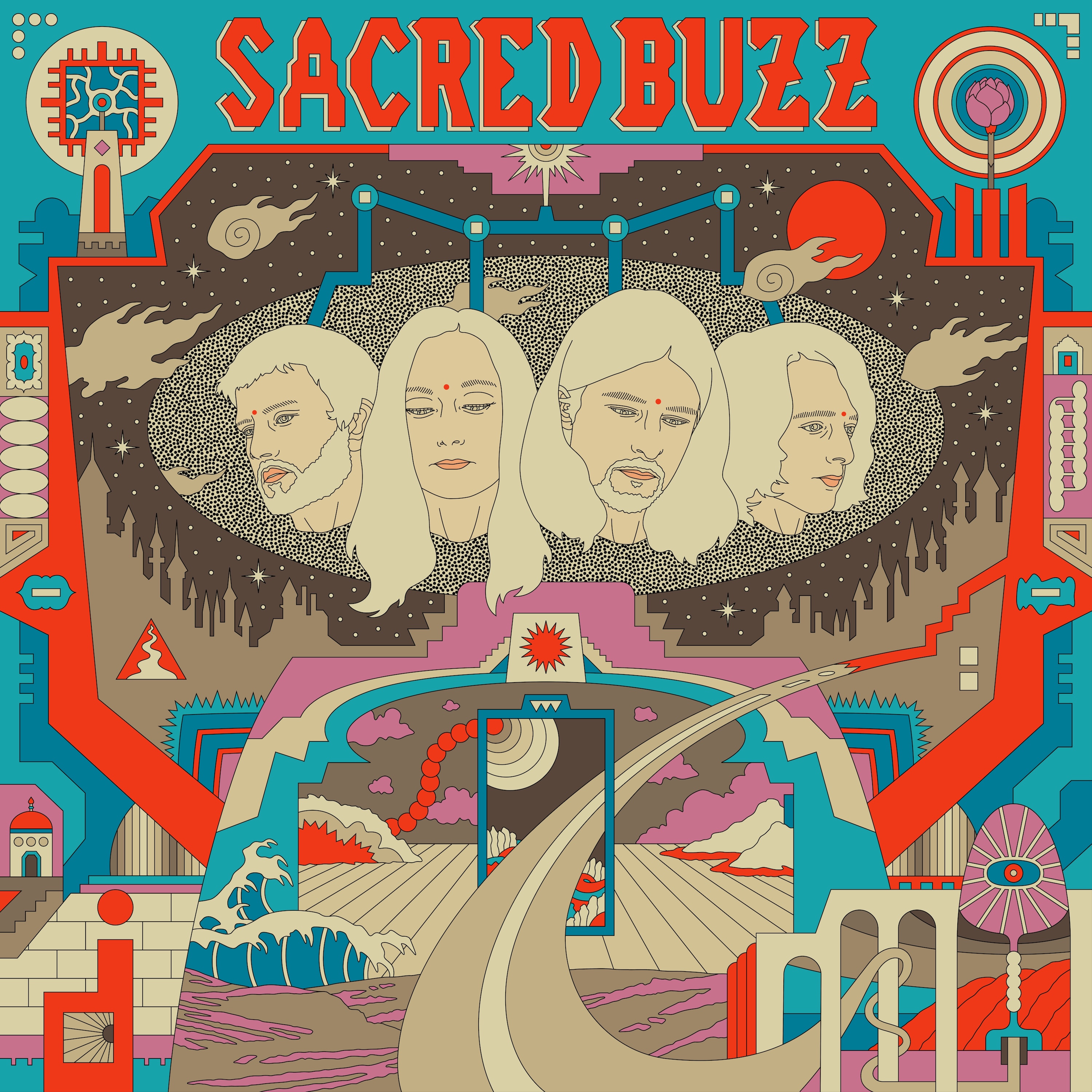
The surreal artwork created by Indonesian illustrator Ardneks consequently feels particularly appropriate. His previous associations with artists and events including Kikagaku Moyo, Night Beats, Khruangbin and Barcelona Psych Fest place him naturally within the broader visual culture surrounding contemporary psychedelia, while the album's science-fiction imagery extends the sense that Sacred Buzz are constructing a world rather than simply packaging eight songs.
Even the physical release reinforces that approach.
Sound Effect Records is preparing several vinyl editions, including standard black, transparent purple and the special Torrent Point Nemo variant, with the promotional information indicating a total production of 400 copies distributed across Europe, the United Kingdom and the United States. A supporting tour is also planned between October and December.
There is something pleasingly tangible about that emphasis on the physical object for music so preoccupied with unstable reality.
More importantly, however, the album appears to represent a significant step between what Sacred Buzz were in 2024 and what they may now be becoming.
Radio Radiation captured the excitement of a young Berlin band discovering the possibilities created by fuzz, drone, garage energy and repetitive rhythm. Sacred Buzz seems prepared to ask what happens when those same ingredients are given considerably more space.
The difference is subtle but important.
The early recordings often felt like psychedelic garage being pulled towards krautrock.
The new material increasingly feels like krautrock providing the gravitational centre around which garage, post-punk and psychedelia are allowed to orbit.
That shift opens considerably more territory.
It allows the darkness of Lost Highway to coexist with the introspection of Nothing to Hide. It creates room for flute, congas, synthesizers and extended textures without requiring Sacred Buzz to abandon the physical impact of a rock band. Most importantly, it allows repetition itself to become part of the album's conceptual language.
If the songs are concerned with reality, illusion, belief and consciousness, then the music continually asks the listener to reconsider what appears to be changing and what actually remains fixed.
The beat continues.
The scenery changes.
Perhaps the listener does too.
It would be premature, before October 9, to decide exactly where Sacred Buzz ultimately leads. Six of its eight destinations remain largely hidden from view, and psychedelic music is rarely improved by having every surprise mapped in advance.
But “Lost Highway” and “Nothing to Hide” already suggest something considerably more interesting than a simple continuation of Radio Radiation.
Sacred Buzz appear to be learning how to transform the raw materials of their early garage psychedelia into something more immersive without polishing away the instability that made those recordings exciting. The fuzz remains, the organ still drones and the rhythm section continues driving relentlessly forward, but the landscape surrounding them has become stranger and considerably larger.
Their debut album may ultimately be less about escaping reality than discovering how easily reality can be rearranged.
And if Sacred Buzz really are building an alternate world from motorik repetition, post-punk darkness, psychedelic fuzz and half-glimpsed science-fiction imagery, the first two doors they have opened suggest that it may be worth getting lost inside it.
© Thusblog
Listen on Qobuz Hi-res (24-bit)