
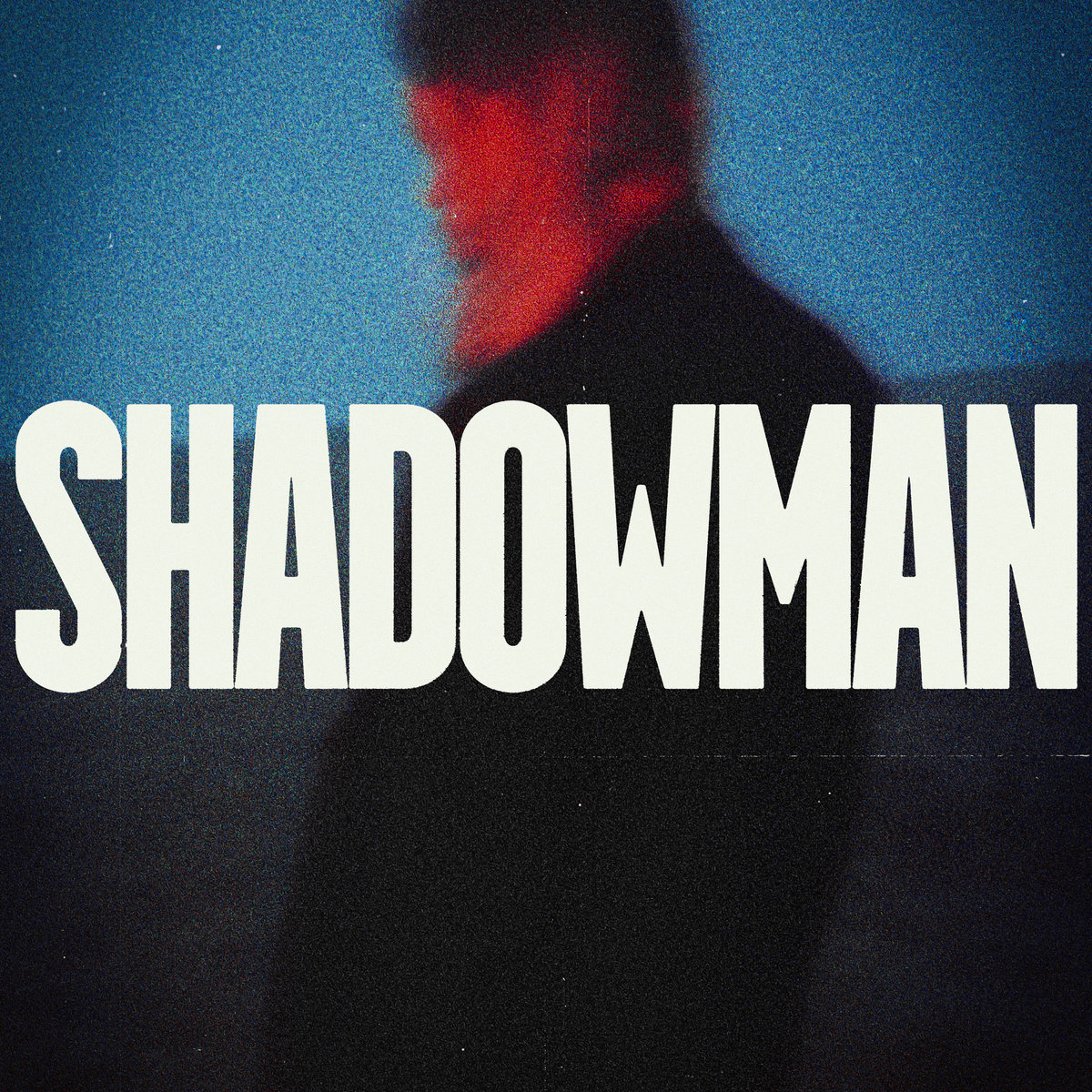
Shadowman - Shadowman
Some collaborations make immediate sense on paper, while others become interesting precisely because the musicians involved bring different instincts into the same room. Shadowman, the new British project bringing together John J Presley, Ben Hillier and Danielle Perry, belongs firmly to the second category. Their self-titled debut album, released on September 4, 2026 through Nica Records / Republic of Music, retains some of the darkness and physical weight associated with Presley's previous work, but places it inside a considerably broader musical landscape where alternative rock, gothic rock, art rock and post-rock coexist with piano, electronics, brass and a distinctly cinematic sense of space.
The origins of the project were relatively modest. Presley had been working on new material while deliberately attempting to concentrate more closely on songwriting rather than allowing sound and texture to determine everything around it. The arrival of a 1970s Guild acoustic guitar, imported from the United States, became an important catalyst for that process. There is something appropriately simple about an acoustic instrument helping to create music that would eventually become so expansive, because the songs on Shadowman frequently retain the impression that something intimate exists beneath even their largest arrangements.
Presley subsequently brought the developing material to Ben Hillier's Agricultural Audio studio near Lewes in Sussex, where the relationship between composition and production began changing the character of the songs. Hillier's presence is particularly significant. As a producer whose career includes work with artists such as Depeche Mode, Elbow and Nadine Shah, he understands how darkness can be created through atmosphere and space rather than simply through volume. His role in Shadowman also extends beyond production, with his drumming becoming fundamental to the physical movement of the record.
Danielle Perry, Presley's longtime collaborator and wife, gradually became equally important to the process, contributing piano, vocals and an orchestral sensibility developed through several years of studying orchestration. What might initially have remained a Presley recording project therefore developed into something more genuinely collaborative. By the time the album took shape, Shadowman had become a trio with a musical identity sufficiently distinct to justify existing under its own name.
Additional musicians help widen that identity even further. Pete Wareham contributes saxophone and brass, while Marcus Hamblett brings further brass arrangements and instrumental textures. Dan Crook handled the recording, capturing performances that were deliberately prevented from becoming excessively refined. The sessions were based around a remarkably immediate principle, with no part requiring more than three takes.
That limitation appears to have been important because Shadowman is an album filled with detail without sounding obsessively constructed. The arrangements can be intricate, but the performances retain the tension of musicians responding to one another in real time. Small imperfections and accidents are allowed to survive rather than being removed in pursuit of technical perfection, which gives the record an interesting contradiction: its world can feel enormous and carefully orchestrated while the musicians inside it remain remarkably close.
This balance between scale and intimacy becomes one of the album's defining characteristics.
There is certainly a gothic quality to Shadowman, although describing the album simply as gothic rock would miss much of what makes it interesting. Its darkness is less concerned with genre iconography than atmosphere. Guitars can become extremely heavy, but they frequently exist alongside piano, synthesizers, motorik drum-machine patterns, saxophone and brass arrangements that can occasionally suggest the strange solemnity of a New Orleans funeral procession. At other moments, the music contracts until little more than a voice and a few carefully placed instruments remain.
The result is a record that often feels nocturnal without becoming monochromatic.
“Flowers” provides one of the clearest introductions to this world. Its guitar carries a pronounced 1980s delay, while synthesizer, drum machine, Perry's piano and Wareham's saxophone gradually complicate the atmosphere. There is something simultaneously intimate and threatening about the arrangement. Individual elements remain recognisable, but together they create the sensation that the song occupies a much larger space than its basic structure might initially suggest.
That ability to enlarge relatively simple compositions without overwhelming them is crucial to Shadowman. The production does not appear designed to demonstrate how many textures can be added to a song. Instead, each new instrument seems to alter the emotional temperature around the central composition.
“You Are The Love” is particularly important in understanding how that approach developed. Presley initially recorded the idea late at night while suffering from a lack of sleep, and some of that strange vulnerability remains embedded in the finished recording. The song begins from relatively exposed vocals before guitar and drums gradually increase the pressure around them.
Rather than separating tenderness from noise, Shadowman allows one to evolve naturally into the other.
That progression seems fundamental to the group's identity. The quieter passages are rarely simply introductions waiting for the guitars to arrive, while the heavier moments do not exist merely to provide dramatic climaxes. Instead, intimacy and volume appear to describe different states of the same emotion. A song can begin exhausted, uncertain or vulnerable and gradually acquire enough physical weight to become overwhelming without losing the fragility that originally set it in motion.
The more narrative “New York In Spring” reveals another possibility. Moving closer to alt-folk, the song places greater emphasis on Presley's storytelling and explores resistance in the face of adversity. Images connected to war and violence are placed against a persistent belief in survival and hope, while the recurring failures of human history provide a darker background.
Its presence is important because it demonstrates that Shadowman's ambition does not depend entirely upon enormous arrangements. The album can create scale through narrative just as effectively as it can through guitar, drums or brass.
Across its ten tracks, including “Don't Assume,” “Wedding Singer,” “On Fire,” “Waiting On The Old Songs,” “Look At You Now,” “Blonde” and closing piece “Summer Sun,” the album gradually allows its songs more room to develop. Some of the earlier material remains relatively compact, while pieces such as Wedding Singer and Summer Sun stretch further and allow the trio's interest in atmosphere to become increasingly prominent.
This gives the record a sense of movement rather than simply presenting ten variations upon the same dark-rock formula.
The most interesting tension running through Shadowman is perhaps the relationship between darkness and warmth. The project's name, its nocturnal production and Presley's heavy guitar language could easily suggest an album built entirely around gloom, but the emotional world of these songs is more complicated. Loss and uncertainty coexist with affection, memory and hope, while the music repeatedly allows light to enter arrangements that initially appear oppressive.
Even the brass contributes to this ambiguity. Depending on the song, it can sound mournful, cinematic, threatening or unexpectedly warm. Perry's piano performs a similar function, sometimes reinforcing the darkness and elsewhere creating a fragile human presence beneath the heavier instrumentation.
This is where Shadowman begins to separate itself most clearly from Presley's solo work.
His musical personality remains unmistakable, particularly in the guitar playing, vocals and attraction towards darker forms of rock, but the other musicians continually redirect those instincts. Hillier's production and drumming alter the architecture surrounding the songs, while Perry's piano, vocals and orchestral understanding introduce colours that would be difficult to regard as simple decoration. Wareham and Hamblett then push that vocabulary further through brass and additional instrumental textures.
The result feels increasingly like a band rather than an artist surrounded by collaborators.
That distinction is important for a debut album carrying the project's own name. Self-titled records often function as statements of identity, and Shadowman certainly feels like three musicians attempting to establish the boundaries of a new musical space. The interesting part is that those boundaries remain deliberately wide.
Alternative rock provides the foundation, gothic rock contributes darkness and tension, while post-rock can be heard in the patience with which certain arrangements accumulate weight. There are also elements of alt-folk, art rock and electronic music, but none appears to have been introduced simply to make the album more eclectic.
Everything serves the atmosphere.
The group's first live appearances in London and Paris in June 2026, both announced as sold out, also allowed Shadowman to begin existing independently before the album itself appeared. That seems particularly appropriate for music recorded with such an emphasis on performance and limited takes. However carefully arranged the record becomes, there remains a sense that these songs were created by musicians who wanted to preserve the possibility of something unexpected happening between them.
Perhaps that is ultimately what gives Shadowman its character.
This could easily have become a meticulously produced exercise in cinematic darkness, particularly with musicians possessing this level of studio experience. Instead, its sophistication is repeatedly interrupted by something human. A guitar becomes abrasive, a drum performance pushes against the arrangement, a saxophone appears from the shadows or a piano exposes a vulnerability that the surrounding production had almost managed to conceal.
The darkness is therefore never completely sealed.
For John J Presley, the album represents a significant expansion of a musical language he had already been developing for years, but Shadowman becomes interesting precisely when it stops feeling like an extension of his existing work. Ben Hillier and Danielle Perry do not simply help decorate Presley's songs; their contributions alter the environment in which those songs exist.
That is why Shadowman feels less like the beginning of a side project than the establishment of a genuinely new entity. Its ten songs suggest a group still discovering exactly how far it can move between intimacy and scale, acoustic songwriting and enormous guitars, gothic darkness and unexpected warmth.
For a project called Shadowman, the most compelling thing about its debut album may ultimately be how much attention it pays to the light surrounding the shadows.
© Thusblog
Listen on Qobuz (Hi-res 24 bit)