
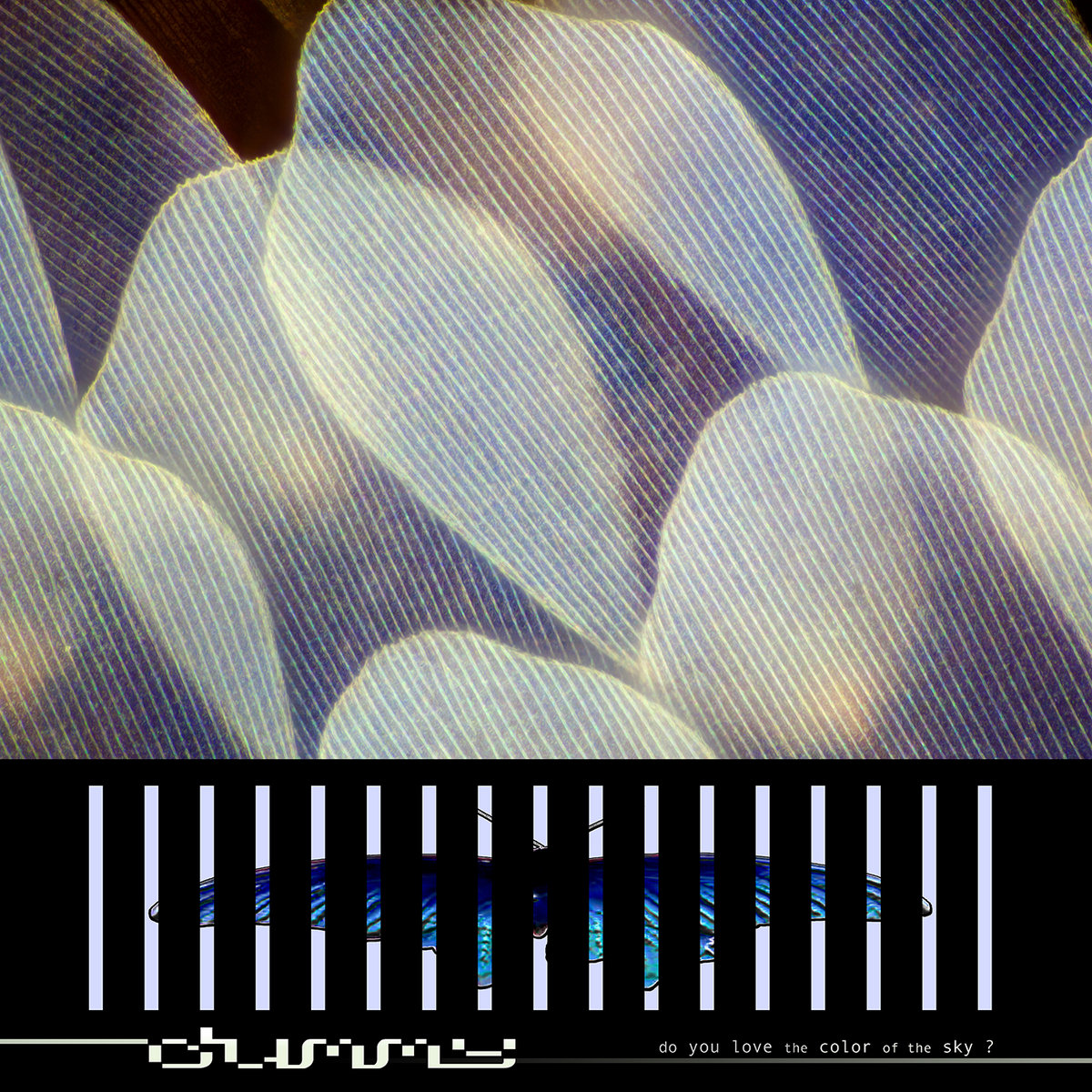
Dummy - Do You Love the Color of the Sky?
Album released October 16, 2026 | Polyvinyl Record Co. | Ambient / Post-Punk / Shoegaze / Psychedelic / Trip-Hop
There is something particularly unsettling about music that sounds almost euphoric while describing a world moving towards an increasingly uncertain future. On their third album, Do You Love the Color of the Sky?, Dummy explore precisely that contradiction, combining luminous melodies, hypnotic rhythms and richly layered guitars with reflections on environmental destruction, technological control and the changing value of human creativity.
Released on October 16, 2026 through Polyvinyl Record Co., the ten-track album marks another significant development for the Los Angeles-based band, whose musical identity has gradually expanded beyond its original shoegaze and post-punk foundations. Drawing increasingly upon ambient music, psychedelia, trip-hop and the experimental electronic sounds of the 1990s, Dummy have created a record that feels both connected to a particular period of alternative music and unusually relevant to the concerns of the present.
Following the explorations of their previous album, Free Energy, the group continue to move away from conventional guitar-based arrangements, introducing a greater emphasis on breakbeat-inspired rhythms, self-sampling and the relationship between rhythmic repetition and atmospheric sound design.
What makes this evolution especially interesting is that Dummy have not abandoned their melodic instincts. Their compositions remain accessible, frequently propelled by memorable vocal lines and an infectious sense of movement, even when the instrumental structures become increasingly abstract.
The band's lineup brings together Joe Trainor and Nathan O'Dell on guitars, Emma Maatman on vocals, Lance Umble on bass and Alex Ewell on drums. Their collective approach allows the music to move between different instrumental traditions without losing the coherence of a recognisable group identity.
The guitars often function less as conventional rock instruments than as sources of rhythm, texture and repetition. Distorted passages coexist with delicate reverberations, while processed guitars and samples of the band's own playing generate seemingly electronic atmospheres, making it difficult to distinguish the original performances from their studio transformations.
Ewell's drumming is particularly important to the album's character. His playing moves between insistent post-punk rhythms, syncopated patterns and breakbeat-inspired structures, giving the music a sense of momentum that prevents even its most atmospheric passages from becoming static.
Above these arrangements, Maatman's airy vocals provide a contrasting melodic presence. Their relative softness often disguises the seriousness of the lyrical subjects, creating an emotional distance between what the music appears to communicate and what the words actually describe.
That relationship between beauty and unease lies at the centre of Do You Love the Color of the Sky?.
The album's title initially suggests a simple appreciation of the natural world, yet the question becomes considerably more complicated when placed alongside the environmental and technological anxieties explored throughout the record.
It invites the listener to consider not only the beauty of the world around us, but also how much of that beauty is being taken for granted as the conditions that sustain it become increasingly fragile.
The opening “April Limousine” establishes this tension immediately.
Driven by lively rhythms and bright melodic textures, the song approaches environmental deterioration without relying upon the sombre musical language that might ordinarily accompany such a subject. Instead, Dummy create an almost uplifting atmosphere, allowing the contrast between the arrangement and the lyrics to emphasise the uncomfortable contradictions of contemporary life.
The music continues moving forward while the words acknowledge a world experiencing profound ecological change. This juxtaposition gives the song a particular emotional ambiguity, suggesting that optimism and anxiety can exist simultaneously rather than cancelling one another out.
“Alluvial Fan” develops the album's interest in the relationship between rhythm and atmosphere. Layers of processed guitar, bass, percussion and self-sampled sounds form an intricate instrumental environment, while the vocal melodies retain a sense of fluidity amid the increasingly detailed arrangements.
Additional backing vocals from Allyson Foster and Paul Benson enrich the composition, reinforcing Dummy's preference for building songs through the interaction of multiple melodic and textural elements.
The track demonstrates how effectively the band can create complexity without sacrificing the underlying sense of movement that makes their music immediately engaging.
One of the album's most pointed moments arrives with “Full Spectrum Dominance,” a single that addresses the growing influence of artificial intelligence and its implications for artistic work.
The song examines the relationship between technological development and the exploitation of human creativity, particularly the use of existing artistic material and intellectual labour in systems that do not necessarily recognise or compensate the people responsible for producing it.
Maatman's concerns extend beyond the technology itself to the wider question of how creative work is valued in an environment increasingly shaped by automation and large-scale data collection.
Musically, the track maintains the album's characteristic contrast between serious subject matter and appealing arrangements. Breakbeat-inspired rhythms and processed guitar textures give the song an immediate sense of accessibility, while its lyrical content encourages a more critical consideration of the systems becoming embedded in everyday life.
The title also introduces a broader idea of control, suggesting that technological influence is not simply a matter of convenience or innovation, but increasingly connected with questions of ownership, power and individual autonomy.
These concerns return later on “N of 1,” which explores the normalisation of surveillance and the gradual acceptance of mechanisms that monitor and influence personal behaviour.
Together, the two songs establish an important thematic connection within the album. Both examine the position of the individual within technological structures whose influence continues to expand, often without the full implications being clearly understood.
Yet Dummy avoid turning these subjects into a collection of straightforward protest songs. Their approach is more indirect, allowing the music's brightness and rhythmic energy to coexist with an underlying sense of uncertainty.
Elsewhere, the album moves further into experimental territory.
“Squeaky Wheel” and “Song of Mana,” both extending beyond six minutes, provide space for more elaborate instrumental development. Their longer structures allow rhythmic patterns, processed guitar textures and self-sampled fragments to evolve gradually, blurring the boundaries between conventional songwriting, post-rock and ambient composition.
“Touch the Perfect Speed” continues the exploration of movement and repetition, demonstrating the group's interest in how subtle changes in rhythm and texture can transform the atmosphere of a piece without requiring dramatic structural shifts.
The appearance of Nina Pitchkites on “Song of Mana” introduces another vocal dimension, adding to the album's varied approach to melody and arrangement.
These more expansive compositions are particularly revealing because they demonstrate how Dummy borrow the structural ideas of electronic music while building their sound from guitars, bass, drums and recordings of their own performances.
Rather than relying on keyboards or synthesizers, the band process their guitars and sample their own performances, using repetition, fragmentation and reassembly to shape the structure and development of the music.
The influence of the 1990s becomes especially apparent in this approach.
There are connections with Seefeel and Laika in the relationship between fragmented rhythms, atmospheric guitars and electronic processing. The more contemplative passages suggest the immersive qualities associated with Windy & Carl, while Dummy's willingness to manipulate and reorganise instrumental sounds recalls the experimental ambitions of Disco Inferno.
These comparisons provide a useful context for the album's sound, particularly its interest in the period when alternative guitar music began incorporating techniques more commonly associated with electronic production.
At the same time, the melodic character of Maatman's vocals introduces another set of reference points.
Elements of Björk, The Sundays and even the atmospheric electronic pop of Madonna's Ray of Light can be heard as broader aesthetic parallels, especially in the combination of delicate vocal melodies and rhythmically adventurous arrangements.
What distinguishes Dummy is their ability to bring these influences into a collective musical language rather than simply reproducing the characteristics of any one artist.
The production plays a central role in maintaining that balance.
Recorded partly in the band's own studio and at Studio 22, Do You Love the Color of the Sky? was produced, recorded and mixed by Dummy in collaboration with Joo-Joo Ashworth, whose previous work includes projects involving Corridor, Automatic and Spiral XP.
Mastering was handled by Mikey Young, a musician and producer closely associated with the Australian independent scene.
The recordings retain the density and spontaneous energy of the band's performances while allowing the individual instrumental layers to remain sufficiently distinct.
This clarity is particularly important given the album's complex arrangements. The breakbeat-inspired rhythms and drums provide a rhythmic foundation, while bass, guitars and their processed, self-sampled layers occupy different levels of the mix, creating an impression of depth without allowing the music to become unnecessarily congested.
The production also emphasises the relationship between repetition and gradual transformation. Small changes in instrumental texture can alter the emotional character of a passage, allowing the songs to develop through accumulation and variation rather than relying exclusively upon conventional changes in melody or harmony.
That approach gives Do You Love the Color of the Sky? a distinctive sense of continuity, even as its compositions move between different stylistic influences.
The album's most compelling quality, however, remains the contrast between its musical character and its thematic concerns.
Environmental anxiety, artificial intelligence, surveillance and the changing relationship between technology and human experience are subjects that could easily encourage a uniformly bleak atmosphere. Dummy instead approach them through music that is frequently colourful, energetic and unexpectedly uplifting.
There is an uncomfortable familiarity to that contradiction. Contemporary life continues to provide entertainment, convenience and technological novelty even as the consequences of those developments become increasingly difficult to ignore.
Dummy capture something of that experience without requiring their songs to deliver definitive answers.
Their music suggests a world in which beauty and uncertainty coexist, where the pleasures of movement, melody and sound remain possible even when the future feels less secure.
With Do You Love the Color of the Sky?, Dummy continue their progression from shoegaze-influenced alternative rock towards a more expansive form of music that draws equally upon post-punk, psychedelia, ambient experimentation and trip-hop.
The group's growing interest in electronic-music techniques, achieved through processed guitars and self-sampling rather than keyboards or synthesizers, has broadened their compositional possibilities, while their melodic instincts ensure that the resulting arrangements remain emotionally engaging.
As their third album and first release for Polyvinyl Record Co., the record represents an important stage in that development, demonstrating how the band can embrace increasingly adventurous production techniques without abandoning the qualities that originally defined their sound.
What makes Do You Love the Color of the Sky? particularly effective is its refusal to separate musical pleasure from contemporary unease. Its rhythms invite movement, its melodies offer moments of genuine beauty, and its lyrics remind us that the world surrounding those experiences is changing in ways that deserve closer attention.
The album's title ultimately becomes more than a question about the colour of the sky. It asks whether we are still capable of appreciating what surrounds us while recognising the forces that threaten to transform it.
© Thusblog
Listen on Qobuz Hi-res 24-bit