
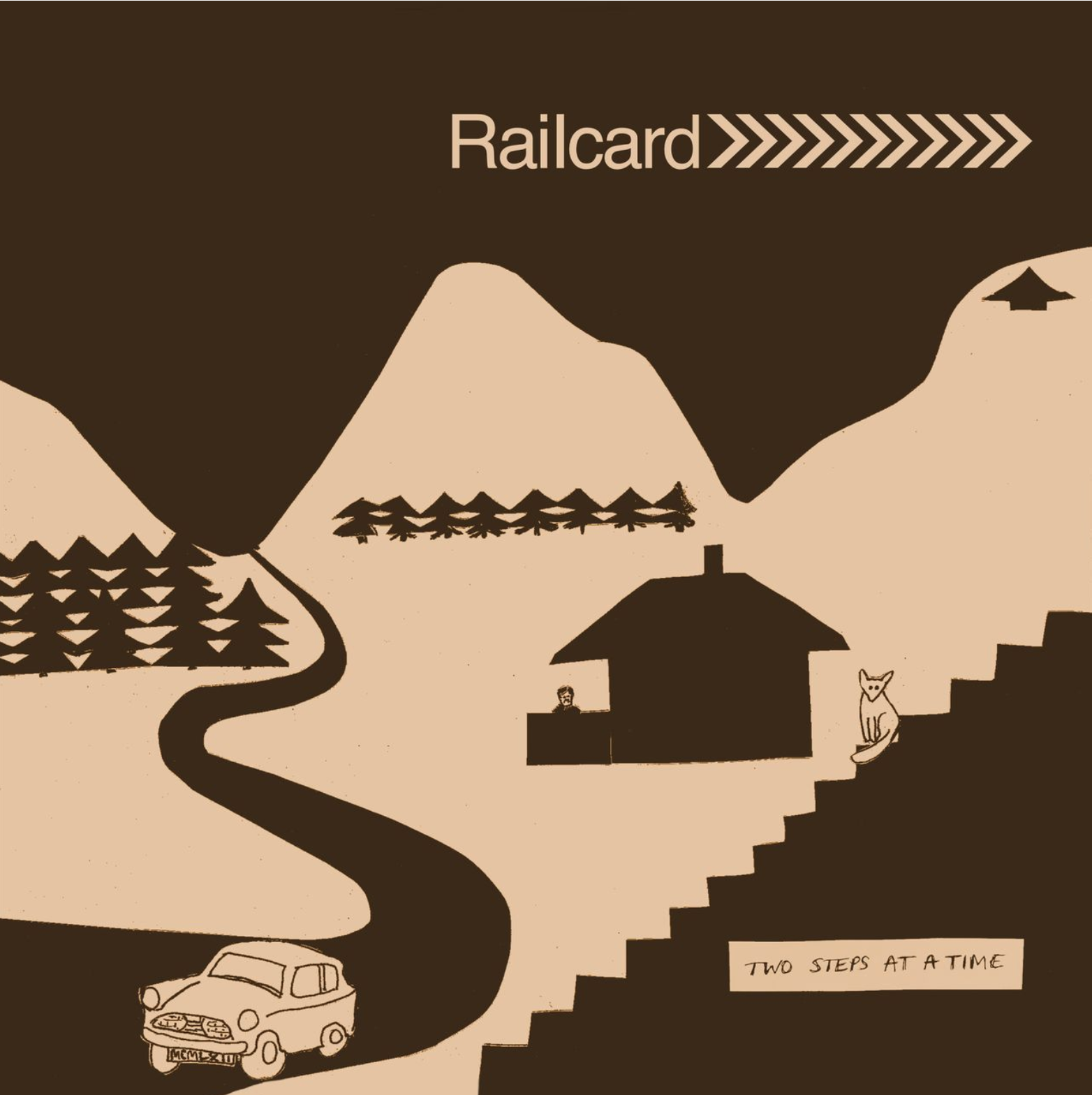
Railcard - Two Steps At A Time
There is something quietly amusing about four musicians with several decades of experience between them forming a new band and discovering that the most liberating thing about getting older might be the possibility of starting again.
Railcard are a relatively recent London indie-pop group, but describing them simply as a new band immediately creates a paradox. Collectively, Rachel Love, Ian Button, Peter Momtchiloff and Allison Thomson connect an extraordinary number of threads running through British independent music, from early-1980s DIY pop and post-punk through C86, Sarah Records, indie pop, northern soul, psychedelia and considerably more besides.
Yet Railcard do not particularly behave like musicians attempting to curate their own history.
Released on September 18, 2026, Two Steps At A Time instead sounds like four people discovering that experience can become useful precisely when you stop treating it as something that needs to be demonstrated.
The beginnings of the group were appropriately informal.
Railcard emerged in 2025, following a meeting between Rachel Love, Ian Button and Peter Momtchiloff at a London concert. Somewhere in the conversation came the discovery that all three had been born in 1962, an apparently trivial coincidence that rapidly became part of the group's identity. Allison Thomson, several years younger, subsequently joined after initially contributing trumpet.
The shared birth year became a running joke, but there is something more interesting underneath it.
Musicians beginning groups in their twenties frequently carry an enormous burden of expectation. Every decision can feel consequential. Every new band is potentially the band. Careers must be built, scenes navigated and identities established.
Railcard begin from somewhere completely different.
These musicians already have histories.
Rachel Love was a member of Dolly Mixture, whose melodic DIY pop became an important part of the British independent landscape of the early 1980s. Ian Button played with Thrashing Doves and later Death In Vegas, alongside a long list of subsequent projects including Papernut Cambridge and Swansea Sound. Peter Momtchiloff connects Railcard with an extraordinary indie-pop lineage through Talulah Gosh, Razorcuts, Heavenly, Marine Research and the Would-Be-Goods. Allison Thomson, meanwhile, has contributed to music involving the Trash Can Sinatras, the Would-Be-Goods, The Orchids and The Gentle Spring.
On paper, that history could make Railcard resemble a carefully assembled indie supergroup.
In practice, they seem almost determined to avoid behaving like one.
There is little virtuoso display and even less sense that listeners are expected to admire the musicians simply because of what they did thirty or forty years ago. Instead, Railcard appear fascinated by the possibility of recovering something that experience can sometimes remove from music: playfulness.
Button has described how much of the competitive pressure surrounding music disappears with age. The idea is almost a kind of second adolescence, except this time adolescence arrives with decades of accumulated knowledge and without quite so much anxiety about whether somebody from a record company is standing at the back of the room.
That spirit is essential to Two Steps At A Time.
Railcard had already moved remarkably quickly before making it. A first Railcard E.P. appeared in October 2025, followed by another EP in December, with several of those recordings subsequently collected alongside additional material on the self-titled Railcard release in February 2026.
Songs such as “Narcissus,” “Born In '62,” “Cherry Plum,” “Revolutionary Calendar,” “Northern Soul Dancing,” “Slow Train” and “Disco Loadout” established a musical world in which British indie pop could coexist happily with 1960s pop, northern soul, psychedelia and occasional motorik rhythms.
Two Steps At A Time, however, represents the first complete Railcard album built from a fresh collection of songs.
Its twelve tracks move through an impressive amount of musical history without sounding particularly interested in announcing each reference as it passes.
There are echoes of 1960s orchestrated pop, folk psychedelia, girl groups, The Kinks and Scott Walker, but also the more homespun traditions of British post-punk and indie pop, the melodic directness associated with Sarah Records and Heavenly, and moments where repetitive rhythms and keyboards inevitably bring Stereolab somewhere into the conversation.
What prevents the record from becoming an exercise in record-collection archaeology is that these influences do not appear to be costumes.
Railcard have lived with this music.
Some of it belongs to their childhood. Some accompanied their adolescence. Some emerged while they themselves were already active musicians. Consequently, the different decades do not seem particularly interested in remaining separated.
A 1960s harmony can sit comfortably beside an indie-pop guitar.
Northern soul energy can encounter motorik repetition.
A trumpet can suddenly wander towards something considerably stranger.
Nobody stops the song to explain which year it is supposed to be.
The group's own descriptions of their music are revealingly modest. Thomson talks about jangly guitars, bouncing rhythms and warm brass, while Button has used the wonderfully understated description “light beat music.” Love emphasises melody, harmony and enjoyment.
All three descriptions are more useful than attempting to force Railcard into an elaborate genre taxonomy.
At the centre of everything are the songs.
Love and Button write most of the material together, while Momtchiloff contributes “Hillman Minx” and “Paper Thin.” The four members also sing, allowing vocal harmonies to become one of Railcard's defining characteristics rather than something added occasionally to decorate a chorus.
That matters particularly because Love has always possessed a strong instinct for harmony.
On Two Steps At A Time, voices frequently seem to pass through one another, providing counter-melodies or subtly altering the emotional colour of a phrase. They contribute significantly to the impression that this is communal pop music rather than a singer accompanied by three musicians.
The instrumentation reinforces that character.
Alongside the expected guitar, bass and drums are keyboards, trumpet, cello and recorder, yet Railcard resist the temptation to turn those additional colours into grand orchestration. Instruments tend to appear because a song has somewhere useful for them to go.
The result is detailed without becoming crowded.
That balance partly reflects the unusual way the group works.
Love and Button frequently begin constructing songs remotely using Logic, exchanging guitars, keyboards, vocals and basic rhythmic structures. Thomson subsequently contributes trumpet and additional harmonies before live drums and bass help give the recordings a more physical character.
The completed tracks are then handed to Allan Crockford for mixing, with the band allowing him considerable freedom in areas such as vocal balance, compression and reverb.
It is an interesting combination of methods.
Railcard's musical vocabulary can sound deliberately old-fashioned, but their working process is entirely contemporary. Files travel between musicians, arrangements develop digitally and performances are assembled progressively rather than requiring four people to stand around a microphone pretending it is 1966.
The warmth is therefore not produced by historical cosplay.
It comes from the musicians.
The opening “Two Steps At A Time” establishes that philosophy efficiently. Concise and melodic, it contains much of what makes Railcard appealing without attempting to overwhelm the listener. This is pop constructed by people who understand that complexity does not need to advertise itself.
“1962 Forever” inevitably plays with the coincidence surrounding the group's formation, but it also touches upon the album's broader fascination with time.
The title can initially sound nostalgic, even defiantly so, but Railcard's relationship with the past is more complicated than simply wishing to return there.
That becomes apparent as the record begins wandering.
Momtchiloff's “Hillman Minx” brings a more nervous quality, with repetitive bass, rougher guitars and trumpet pushing against the group's sweeter melodic instincts. “Flannelette” travels in almost the opposite direction, moving closer to dream pop as organ, harmonies and brass float around a deliberately uncomplicated rhythmic foundation.
Then there is “Unstable Neighbour,” where repetition begins pulling Railcard towards more motorik territory.
The Stereolab comparison becomes understandable here, not because Railcard suddenly attempt to imitate them, but because both groups recognise how effective a simple repeated rhythm can become when melodic and textural details are continually rearranged above it.
“Runaround” finds yet another possibility, allowing trumpet to become unexpectedly unruly, with brief passages approaching the freedom of jazz without allowing the song itself to disintegrate.
This willingness to introduce small disruptions is important.
Railcard's melodies can be so immediately charming that a less imaginative group might simply settle into prettiness. Instead, odd rhythmic decisions, unexpected instruments and slightly abrasive textures repeatedly prevent the album from becoming excessively comfortable.
“Paper Thin” is perhaps one of the clearest examples.
Momtchiloff has connected the song with the sensory confusion of nightmares and feverish states, giving Railcard's usually bright musical vocabulary a more unstable psychological quality. Familiar pop elements remain, but their relationship becomes less secure.
That tension between familiarity and slight disorientation runs quietly through much of the record.
Railcard understand the reassuring language of classic pop extremely well. They know where harmonies naturally want to resolve and how melodic structures create expectation. Precisely because they understand those rules, they can occasionally move something a few centimetres away from where the listener expects to find it.
“Snow Blind” demonstrates the same skill from another direction.
Its apparent simplicity conceals a considerably more elaborate harmonic progression, illustrating one of the pleasures of Two Steps At A Time. Many of these songs reveal themselves immediately enough to feel almost effortless, but repeated listening begins exposing how carefully they have actually been assembled.
The trick is that Railcard rarely draw attention to the workmanship.
They make difficult things sound easy.
That may ultimately be one of the advantages of experience.
A younger band discovering an unusual chord progression might be tempted to make sure everybody notices it. Railcard can simply put it inside a pop song and continue.
The album closes with “Sunday Sun,” completing a collection that manages to travel through numerous corners of British pop history without turning the journey into a lecture.
And history is unavoidable when discussing this band.
Railcard themselves recognise that nostalgia becomes increasingly complicated with age. Momtchiloff has acknowledged the natural tendency to remember earlier periods affectionately while also recognising the danger of allowing that affection to become a comfort zone.
Button's perspective is particularly interesting because Railcard can sound retro for a very simple reason: these musicians were actually there.
They are not younger artists attempting to reconstruct an imagined version of the 1960s, 1980s or 1990s entirely through records, photographs and vintage equipment. Those periods overlap with their own lives.
The distinction matters.
Memory is not the same thing as revivalism.
And Two Steps At A Time often feels like an album about the difference.
Railcard are capable of drawing upon decades of musical memory without insisting that any particular decade represented a lost golden age. The Ronettes, The Kinks, northern soul, post-punk DIY, Heavenly, Sarah Records, Stereolab and dream pop can all exist inside the same musical conversation because the musicians do not treat history as a sequence of sealed rooms.
They have walked through most of them already.
Perhaps that explains why the record feels so relaxed.
There is no obvious attempt to prove that Railcard remain relevant, because relevance itself seems to be largely beside the point. Nor is there a desperate effort to sound contemporary. The group simply uses whatever part of its enormous collective vocabulary seems appropriate for the song being written.
That freedom gives Two Steps At A Time something surprisingly youthful.
Not youthfulness in the artificial sense of musicians attempting to disguise their age, but the more valuable quality of curiosity without excessive self-consciousness.
The title becomes particularly appropriate in that context.
After careers spanning several decades, Railcard could reasonably be expected to approach another musical project with elaborate plans and considerable caution.
Instead, they appear to be doing something much simpler.
Write another song.
Try another harmony.
Add a trumpet.
See where it goes.
Then take another step.
For a band containing musicians whose histories stretch across such an extraordinary portion of British independent pop, Two Steps At A Time succeeds because it does not feel like a retrospective. Railcard are not attempting to recreate their youth, and they certainly do not need to demonstrate that they remember how indie pop works.
They helped live through much of the history from which it emerged.
What makes this album so appealing is the sense that, after all those years, making pop music can become uncomplicated again. Not musically uncomplicated, because beneath these apparently effortless songs are sophisticated harmonies, arrangements and decades of accumulated instinct, but emotionally uncomplicated.
Four musicians can make a record because making a record still feels good.
They can remember the past without moving back into it.
And perhaps that is the real significance of Two Steps At A Time. Railcard have spent a lifetime collecting musical memories, but this album sounds like four people far more interested in deciding what to do with them next.
© Thusblog
Listen on Qobuz Hi-res (24-bit)